Bridge Integration
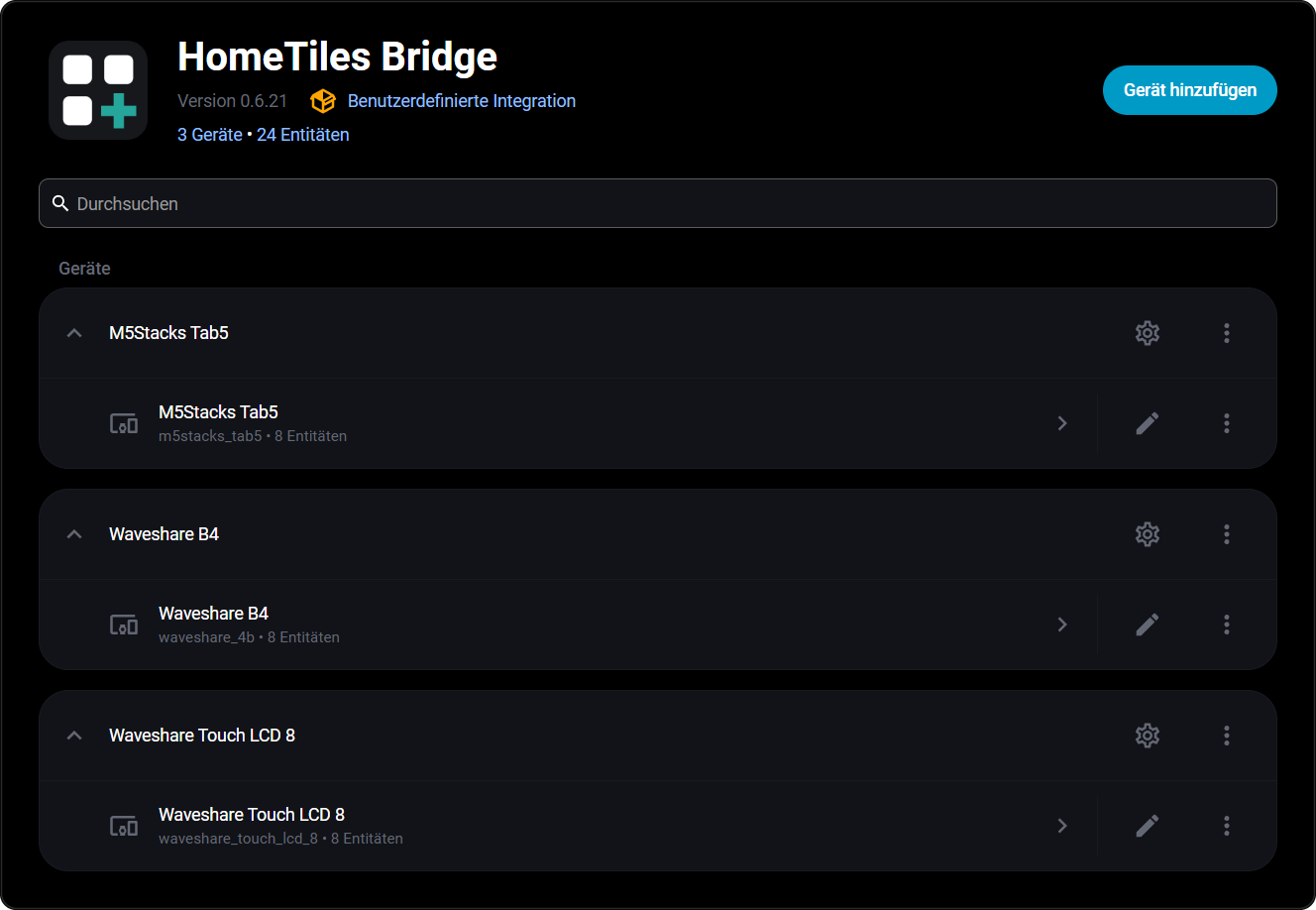
The HomeTiles Bridge connects your displays to Home Assistant over MQTT. It shares entity data and sends tile actions back to Home Assistant, with each display listed as its own device.
Installation
You need Home Assistant 2025.11 or newer, an MQTT broker, and HomeTiles Bridge v0.7.0 or newer for all documented features with firmware v0.7.0. Follow the Home Assistant setup guide to install the Bridge and pair your first display.
HACS provides Bridge updates. After an update, restart Home Assistant. For additional displays, follow Multiple displays.
Configuration
Open Settings → Devices & Services → HomeTiles Bridge → Configure.
Panel Settings
| Field | Setting |
|---|---|
| Base topic | Must match Device topic base in the display's MQTT settings. Each display needs a unique value. |
| HA prefix | Default: ha/statestream. Use the same value on the Bridge and all displays. |
| Device name / manufacturer / model | Optional details shown in Home Assistant. |
Entity Configuration
Select the sensors, binary sensors, numbers, selects, date/time entities, weather, lights, switchable entities, covers, fans, locks, alarm panels, climate entities, media players, cameras, and scenes/scripts/buttons you want to use. Then assign them to tiles in the Web Admin.
Selections are shared across all displays. Action aliases are generated automatically and remain stable when selections are reordered; custom aliases use one alias=entity_id per line.
Switches / switchable entities accepts switch, input_boolean, automation, fan, humidifier, remote, and siren. They use the existing Switch tile and its on/off popup; lights retain brightness/color controls. Automations are enabled/disabled. Fan and Siren require HA support for both on and off.
Scenes / Scripts / Buttons accepts scene, script, button, and input_button. Assign these to the existing Scene tile: a tap activates the scene, starts the script without parameters, or presses the button once. See the compatibility table for exact behavior and limits. Use updated firmware for the complete availability handling and translated editor labels.
Older display configurations, entity selections, aliases, and MQTT topic names remain valid. Commands must target selected entities; retained switch/action commands are ignored on reconnect.
Numbers accepts number and input_number; Selects accepts select and input_select; Date/Time accepts time, date, datetime, and input_datetime. Use their dedicated editable tile types. State, writable limits, options, availability, and history come from Home Assistant. Recorder exclusions also apply to these history views.
Fans, Locks, and Alarm panels feed the Fan, Lock, and Alarm Panel tiles (Bridge v0.8.0). Locks and alarm panels can only be operated from a display with encrypted commands and a Web Admin password. Codes for locks and alarm panels lets the Bridge check the codes of devices that ignore a wrong code; Allow opening without a code is only for devices without their own code. Fans also remain selectable as switchable entities.
Bridge v0.8.0 remains compatible with older firmware and existing configurations. New features require the corresponding firmware; no reset or re-pairing is needed for a normal update.
Control the Displayed View
Each compatible display exposes a View Select entity (Ansicht in German) on its existing Home Assistant device, next to the display controls. It offers Home, configured folders including nested folders, and configured tiles with supported popups.
Choosing an option opens that target using the existing display navigation and popup. Manual navigation and closing a popup report the actual view back to HA. Opening another popup closes the previous one and releases its resources, including a camera stream. Folder PIN protection remains in effect.
Options contain the folder path and a stable target suffix, so identical names remain distinguishable. Renaming or moving a tile updates its label; deleting it removes the option. Titles with line breaks remain two lines on the display but become one line in this list. Update an automation's option text if you rename or move its target.
For example, use these actions after your doorbell trigger. Replace the Select entity and camera option with the exact values shown by your own display:
actions:
  - action: select.select_option
    target:
      entity_id: select.hall_display_view
    data:
      option: "Home / Entrance camera [t:12]"
  - delay: "00:00:20"
  - action: select.select_option
    target:
      entity_id: select.hall_display_view
    data:
      option: "Home"
Commands to offline displays or missing targets are rejected. Status updates do not navigate, and old commands are not replayed after a restart or MQTT reconnection. Camera targets are available only on ESP32-P4.
Energy Dashboard
Enable the electricity, gas, or water categories you need. Each requires the corresponding data in Home Assistant's Energy Dashboard. These selections are also shared across displays.
Encrypted Commands
Optional. Anyone who can publish on your MQTT broker could otherwise send commands in the display's name. With encryption, the Bridge runs only commands that the paired display encrypted and signed, each at most once, and camera stream tokens travel encrypted as well. Entity states, weather, history and camera images stay unencrypted.
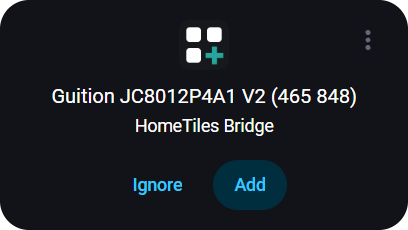
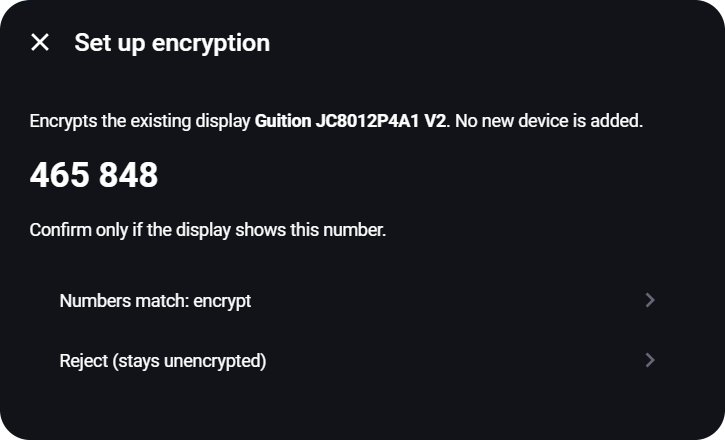
- On the display, open Settings → System → Security and tap Encrypt.
- The display and Home Assistant show the same six-digit number. Confirm only if both numbers match, on the display and in Home Assistant.
- The shield turns green: commands are encrypted. The display stays the same Home Assistant device; nothing is added.
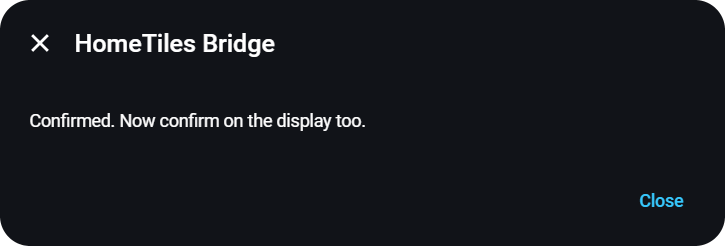
To switch encryption off, tap Turn off on the display or use Security in the Bridge options; the other side follows. A display that was never paired, and older firmware or Bridge versions, keep working unencrypted; with an older Bridge the display asks for a Bridge update. Protocol details: command-encryption.md.
Local Hardware Entities
Configure GPIO switches, onboard relays, and DS18B20 inputs on the display's I/O tab. The Bridge adds them to that display's Home Assistant device automatically; they do not belong in the shared entity selection.
Saving an assignment announces it again. Deleting it makes the old Home Assistant entity unavailable. Names you changed manually in Home Assistant are preserved.
Retired Automatic Sensors
Bridge migration removes obsolete integration-owned battery and external-temperature entries only when they do not match the display's reported capabilities. It also cleans the corresponding shared selections and configuration, so ordinary restart or re-pairing does not recreate them. Devices without implemented battery measurement no longer advertise a battery sensor.
Configured local I/O and supported sensors are preserved, as are explicitly selected user entities. This cleanup does not delete arbitrary entities because their name contains Tab5.
Experimental Camera Transport
Camera tiles are available on ESP32-P4. Allow the display to reach the Home Assistant host on TCP ports 8124–8131. The Bridge sends display-sized JPEG frames directly over the local network; MQTT handles camera control.
Each open display uses its own stream. Video conversion uses Home Assistant CPU time, while snapshot cameras are limited by their source refresh rate. See Camera troubleshooting if no video appears.
Built-in Camera
Displays with a camera can share it with Home Assistant. This needs HomeTiles v0.7.0 and Bridge v0.7.0 or newer.
| Display | Camera |
|---|---|
| Guition JC8012P4A1 V2 and V1 | Built-in OV02C10 |
| Guition JC1060P470C V2, JC4880P443 | Optional OV02C10 module on the CSI connector |
| Waveshare ESP32-P4 7-inch, 8-inch, 10.1-inch | Built-in OV5647 front camera |
| Waveshare ESP32-P4 7B, 4.3-inch, 4B | Optional OV5647 module on the CSI connector |
| M5Stack Tab5 | Built-in SC2356 |
Tested on the Guition JC8012P4A1 V2, Waveshare 8-inch, and M5Stack Tab5. On the other displays, use Rotation, Mirror image, or Swap red and blue under Advanced if the image appears turned or its colors are swapped.
- In the Web Admin, open Settings → Built-in camera and enable Allow Home Assistant to use the built-in camera, then press Save.
- The Bridge adds a Camera entity to the display's Home Assistant device, plus a Camera switch that pauses it.
- Open the camera in Home Assistant, or show it on another display with a Camera tile.
The display captures images only while Home Assistant asks for them. Opening the camera starts a live stream that uses the same TCP ports 8124–8131 as camera tiles; it stops a few seconds after the last viewer closes. While the camera is in use, the display shows the camera indicator. Tapping its pill ends the current stream.
Disabling the setting removes the entity. The paused switch keeps the entity but sends no images. A display cannot show its own camera in its own camera popup.
MQTT Topics Reference
Entity states use <HA prefix>/<entity>/.... The Bridge publishes them itself; Home Assistant's MQTT Statestream integration is not required.
Topic reference for debugging
{id} is the panel device ID; <base> is its unique base topic.
| Topic | Direction | Purpose |
|---|---|---|
<base>/stat/connected |
Display → HA | Connection status |
<base>/view/catalog/* |
Display → HA | Available navigation targets |
<base>/stat/view |
Display → HA | Confirmed current view |
<base>/cmnd/view |
HA → Display | Navigate to a current target |
<base>/cmnd/value |
Display → HA | Validated Number, Select, or Date/Time edit |
<base>/stat/value |
HA → Display | Editable command result |
tab5_lvgl/config/{id}/bridge |
Display → HA | Device and local I/O announcement |
tab5_lvgl/config/{id}/bridge/apply |
HA → Display | Configuration |
tab5_lvgl/config/{id}/bridge/icons |
HA → Display | Icon updates |
tab5_lvgl/config/{id}/history/* |
Both | Sensor history |
tab5_lvgl/config/{id}/weather/* |
Both | Weather forecasts |
tab5_lvgl/config/{id}/energy/* |
Both | Energy data |
<base>/cmnd/light |
Display → HA | Light controls |
<base>/cmnd/switch |
Display → HA | Compatible on/off controls |
<base>/cmnd/media |
Display → HA | Media controls |
<base>/cmnd/climate |
Display → HA | Climate controls |
<base>/cmnd/cover |
Display → HA | Cover controls |
<base>/cmnd/scene |
Display → HA | Scene/script activation or button press |
<base>/cmnd/camera |
Display → HA | Open/close a camera session |
<base>/stat/camera |
HA → Display | Camera connection and status |
<base>/cmnd/local_camera |
HA → Display | Still image or live stream request for the built-in camera |
<base>/stat/local_camera |
Display → HA | Built-in camera status (ready, disabled, error) |
<base>/cmnd/display_brightness |
HA → Display | Display brightness (1–100%) |
<base>/stat/display_brightness |
Display → HA | Current display brightness |
<base>/cmnd/screensaver_brightness |
HA → Display | Screensaver brightness (1–100%) |
<base>/stat/screensaver_brightness |
Display → HA | Current screensaver brightness |
<base>/cmnd/io/{channel_id} |
HA → Display | Local Switch command (ON / OFF) |
<base>/stat/io/{channel_id} |
Display → HA | Local Switch or temperature state |